Agriculture Advancement and the Need to Rise Production
Agriculture has always been the backbone of human civilization, providing food, raw materials, and economic stability. However, the 21st century brings unprecedented challenges: a rapidly growing population, shrinking arable land, unpredictable climate patterns, and the urgent need for sustainable resource use. To address these challenges, agriculture must undergo a technological transformation.
Modern advancements, particularly in geospatial technologies, GNSS-enabled solutions, and precision agriculture, are revolutionizing how farmers plan, manage, and monitor their fields. These innovations not only enhance productivity but also ensure long-term sustainability, efficient resource use, and improved profitability.
In the UAE and beyond, the demand for advanced agricultural solutions is on the rise playing a pivotal role in bringing cutting-edge technology to the field, enabling farmers to meet future food demands efficiently.
1. The Rising Need to Boost Agricultural Production
Global population is expected to exceed 9.7 billion by 2050, increasing food demand by more than 50%. Simultaneously, available arable land is declining due to urbanization, soil degradation, and environmental stress. Farmers are therefore tasked with producing more food on less land, using fewer resources and with minimal environmental impact.
Traditional farming methods, which rely heavily on manual observation and generalized input application, are no longer sufficient to meet these growing needs. Instead, data-driven decision-making and advanced technologies are becoming essential to improve productivity and sustainability.
2. Agricultural Advancements Reshaping the Industry
Agriculture is undergoing a technological revolution driven by digitalization, automation, and precision tools. Some key advancements include:
a. Precision Agriculture and GNSS Technology
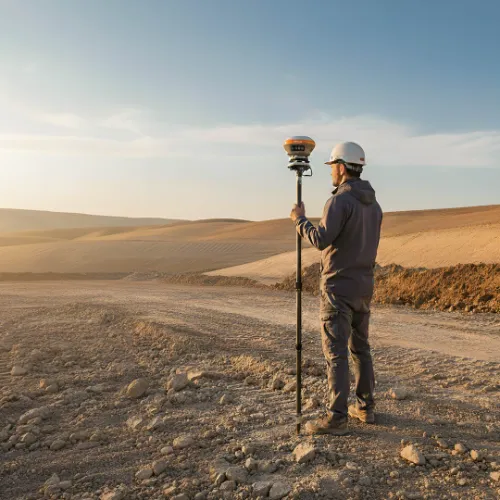
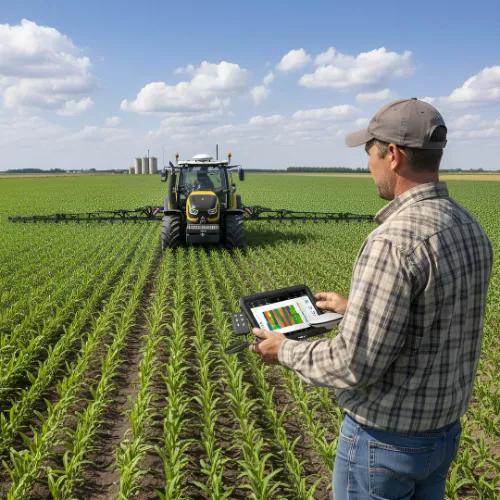
Precision agriculture uses GNSS receivers, sensors, and data analytics to enable site-specific management of crops. Instead of treating an entire field uniformly, farmers can now analyze variability within the field and apply water, fertilizer, and pesticides precisely where needed.
This approach significantly improves efficiency, reduces input costs, and enhances yield while minimizing environmental impact.
b. Autonomous and GNSS-Guided Machinery
Tractors and implements equipped with GNSS guidance systems can automatically follow precise paths, reducing overlaps and gaps during seeding, spraying, and harvesting. This level of precision was unimaginable just a few decades ago and now plays a key role in optimizing field operations.
c. Remote Sensing and Drones
Multispectral drones and satellite imagery provide farmers with real-time information on crop health, soil moisture, pest infestations, and nutrient deficiencies. This data helps farmers take timely corrective measures and monitor large areas efficiently.
d. Smart Irrigation Systems
Advanced irrigation systems combined with GNSS and sensor technologies enable precise water distribution, ensuring crops receive optimal moisture while conserving water a critical factor in arid regions like the UAE.
e. Data Analytics and Farm Management Platforms
Modern agriculture increasingly depends on cloud-based platforms that compile GNSS data, sensor readings, and weather information to support data-driven decisions, making farm management more efficient and transparent.
3. Why Production Needs to Rise – Global & Regional Perspectives
The need to increase agricultural production is driven by several critical factors:
a. Population Growth: Rising global food demand requires a substantial increase in crop yields.
b. Urban Expansion: Agricultural land is being converted for housing and infrastructure.
c. Climate Change: Irregular weather patterns and extreme conditions challenge traditional farming practices.
d. Sustainability Goals: Increasing output must go hand in hand with reducing the environmental footprint.
e. Food Security: Countries are prioritizing domestic production to reduce dependence on imports and stabilize supply chains.
For regions in UAE, where arid conditions and limited natural resources pose unique challenges, advanced technologies like GNSS-based precision agriculture are critical for sustainable growth.
4. SV’s Role in Driving Agricultural Transformation
SV (Surveying Vision), the exclusive CHCNAV agent in the UAE, plays a leading role in bringing geospatial and GNSS-enabled solutions to the agricultural sector. By providing farmers, agribusinesses, and agricultural authorities with advanced equipment and support, SV is enabling the transition toward smarter and more efficient farming.
SV’s contribution includes:
a. Supplying precision GNSS systems for auto-steering, land leveling, and accurate field mapping.
b. Providing training and technical support to farmers and agricultural enterprises.
c. Offering solutions tailored to local conditions, including arid-zone irrigation challenges.
d. Supporting integration with modern farm management platforms to optimize productivity.
With SV’s technology and expertise, farmers in the UAE can achieve higher yields, reduce input costs, and adopt more sustainable farming practices aligning with both national food security goals and global sustainability objectives.
5. Benefits of Modern Agricultural Technologies
The adoption of GNSS and precision agriculture brings a range of tangible benefits:
a. Higher Yields: Targeted management improves crop health and output.
b. Resource Efficiency: Reduced water, fertilizer, and pesticide wastage.
c. Cost Savings: Automation and precise application lower operational costs.
d. Environmental Protection: Minimizing chemical runoff and water wastage supports sustainable farming.
e. Operational Consistency: GNSS guidance ensures uniform operations, improving product quality.
For farmers and agribusinesses, these benefits translate into better profitability, resilience to challenges, and long-term viability.
6. Looking Ahead – The Future of Agriculture
Agricultural technology is continuously evolving. Some exciting trends shaping the future include:
a. AI and Machine Learning: Enabling predictive analysis for smarter decision-making.
b. 5G Connectivity: Improving real-time data transmission for precision operations.
c. Robotics: Automating seeding, weeding, and harvesting for labor efficiency.
d. IoT Integration: Connecting all farm components for centralized, intelligent management.
e. Sustainable Practices: Balancing productivity with environmental stewardship.
SV is committed to staying at the forefront of these trends, ensuring that the UAE’s agricultural sector can keep pace with global innovations.
Conclusion
The advancement of agricultural technology is not a luxury it’s a necessity. As population growth accelerates and resources become increasingly scarce, rising agricultural production sustainably is essential.
GNSS-enabled precision agriculture, smart irrigation, autonomous machinery, and data-driven platforms are reshaping how food is produced. Through its technological expertise and trusted partnerships, SV (Surveying Vision) is helping farmers and agricultural organizations across the UAE embrace these advancements confidently.
By integrating modern technology with agricultural knowledge, we can secure the future of food production, protect resources, and build a smarter, more sustainable farming ecosystem.