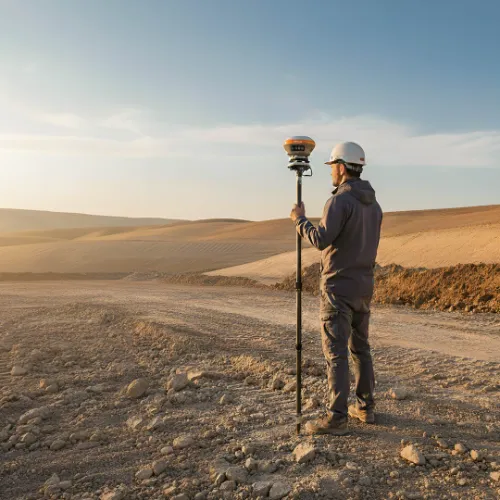
GNSS Receivers Advancement in Land Survey
In the rapidly evolving world of surveying and geospatial sciences, accuracy, efficiency, and reliability are critical to every project’s success. Traditional surveying techniques have served the industry for centuries, but the introduction of Global Navigation Satellite System (GNSS) receivers has completely transformed how surveyors capture and process spatial data.
Modern GNSS technology has become a cornerstone in land surveying, construction, infrastructure planning, agriculture, and environmental monitoring, delivering centimeter-level accuracy faster than ever before. With continuous innovations, GNSS receivers now empower professionals to work smarter and more efficiently even in challenging environments.
As one of the leading providers of geospatial solutions in the UAE, SV (Surveying Vision) has been at the forefront of introducing advanced GNSS technologies to the region, enabling industries to adopt reliable, world-class surveying methods.
1. Evolution of GNSS in Land Surveying
Land surveying has traditionally relied on instruments such as theodolites, levels, and total stations, all of which required clear lines of sight and were often labor-intensive. The introduction of GNSS revolutionized this process by allowing surveyors to measure positions accurately without intervisibility between points.
Early GNSS equipment relied on single-frequency GPS signals, which were vulnerable to errors caused by atmospheric interference and satellite geometry. Over time, multi-constellation and multi-frequency GNSS receivers emerged, integrating signals from multiple global systems such as GPS (USA), GLONASS (Russia), Galileo (EU), and BeiDou (China).
This advancement dramatically improved signal availability, positional accuracy, and reliability, making it possible to survey in dense urban environments, under tree canopies, and over large areas efficiently.
2. Key Technological Advancements in GNSS Receivers
Modern GNSS receivers are equipped with a range of sophisticated features that deliver high performance in demanding conditions. Some notable advancements include:
a. Multi-Constellation Support
Today’s receivers can simultaneously track multiple satellite systems, ensuring stronger signal coverage and minimal downtime, even in difficult environments like construction sites or dense urban zones.
b. Multi-Frequency Capabilities
Dual- and triple-frequency receivers correct atmospheric delays more effectively, reducing convergence times and increasing measurement accuracy.
c. RTK and Network RTK
Real-Time Kinematic (RTK) technology allows surveyors to achieve real-time centimeter-level accuracy, using correction data from a base station or network. Network RTK further improves coverage by using data from multiple stations.
d. Advanced Antenna & Signal Processing
Modern GNSS antennas are designed to reduce multipath errors, while built-in processors filter noise and maintain stable solutions, ensuring reliability in all terrains.
e. Sensor Integration
Many advanced GNSS receivers now include IMUs (Inertial Measurement Units), total stations, and laser scanners, ensuring uninterrupted positioning when satellite signals are weak.
3. Benefits for the Land Surveying Industry
The impact of GNSS advancements on the surveying industry is profound. Some key benefits include:
High Precision: Achieving centimeter-level accuracy consistently.
Increased Speed: Field data collection that used to take days can now be completed in hours.
Reduced Manpower: A single surveyor with a GNSS rover can handle tasks previously requiring teams.
Operational Flexibility: Work is possible in more environments, including areas with partial obstructions.
Cost Efficiency: Faster workflows reduce overall project costs and increase profitability.
These benefits are particularly valuable in large-scale infrastructure projects, cadastral surveys, topographic mapping, and construction layout, all of which require high reliability.
4. SV’s Role in Driving GNSS Adoption
As the exclusive CHCNAV agent in the UAE, SV (Surveying Vision) plays a pivotal role in bringing the latest GNSS receiver technologies to the regional market.
SV provides a complete solution ecosystem that includes:
Supply of advanced GNSS equipment from global leaders like CHCNAV.
Expert installation, training, and support for smooth integration into workflows.
Customized solutions tailored to the unique surveying needs of construction, infrastructure, marine, and agricultural sectors.
After-sales service and technical support to ensure consistent performance and reliability in the field.
By partnering with SV, surveyors and organizations gain access to state-of-the-art GNSS technology, enabling them to tackle projects of any scale with precision and confidence.
5. Applications Across Land Surveying Scenarios
Modern GNSS technology is being applied across diverse land surveying scenarios, including:
Cadastral and Boundary Surveys – Establishing legal property lines with high precision.
Topographic Mapping – Generating accurate terrain models for planning and design.
Construction Layout and Staking – Positioning infrastructure elements on-site in real time.
Deformation and Structural Monitoring – Detecting minute movements in critical infrastructure.
Agricultural Land Management – Mapping and dividing large tracts for efficient cultivation.
SV supports professionals across all these applications by providing reliable equipment, consultation, and field support to ensure optimal performance.
6. Future of GNSS in Land Surveying
The advancement of GNSS receivers continues to accelerate. Some emerging trends include:
Integration with AI & Cloud – Automated processing, real-time error detection, and cloud-based data sharing.
PPP (Precise Point Positioning) – High accuracy without relying on local base stations.
Miniaturization – Smaller, lightweight receivers for greater portability.
Automation & Drones – Autonomous surveying through UAVs combined with GNSS technology.
5G Connectivity – Faster correction delivery for seamless real-time workflows.
SV remains committed to introducing these emerging technologies to surveyors in the UAE, ensuring they remain competitive and ready for the future.
Conclusion
The advancement of GNSS receivers has revolutionized land surveying, offering unmatched accuracy, speed, and efficiency. These innovations have made complex surveying tasks easier, more cost-effective, and highly reliable.
SV (Surveying Vision) stands as a trusted partner in this transformation, equipping surveyors and organizations across the UAE with the latest GNSS technologies, professional support, and industry expertise. By embracing these advancements, companies can enhance project quality, meet deadlines more efficiently, and lead confidently in the era of smart infrastructure and precision surveying.